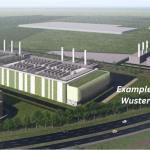


According to a pact with the state, Amazon Web Services intends to invest $35 billion in new data centres in Virginia, according to Friday’s announcement by Governor Glenn Youngkin.
The deal still needs parliamentary approval for the millions of dollars in incentives to complete, but leaders of the General Assembly from both parties indicated support in a news release from Youngkin’s office.
Data centres are still a contentious political issue, especially in northern Virginia, where the buildings are becoming more prevalent and where neighbours are raising issues with noise and the environment.
The technology and computer servers needed to support current internet usage are housed in data centres, and demand is rising. However, the large cooling capacity and powerful fans needed for the data centres might create noise. Additionally, they use enormous amounts of electricity, which may necessitate the building of high-voltage transmission lines to support them.
This year’s legislative proposals would tighten the restrictions on potential centre locations.
The locations of the data centres, which must be constructed by 2040, will be decided at a later time, according to the governor’s office. However, tech companies favour northern Virginia because it is close to the historical internet backbone. Being close to these connection points offers nanoseconds of advantage, which is crucial for tech companies that depend on the servers to support time-sensitive applications like gaming, financial transactions, and other technologies.
Bill Wright, a resident of Prince William County, said Friday’s announcement demonstrates that “the influence of big tech money has become intoxicating to our politicians.” Wright had opposed a significant data centre expansion that had recently been approved by the county’s Board of Supervisors despite strong community opposition.
He stated that he has no issues with data centres in and of themselves and hopes that the state will locate them in environmentally friendly locations and in rural areas where there is a demand for jobs. However, he expressed doubt about the state’s willingness to oppose tech firms that want to locate their operations in northern Virginia.
These issues are overwhelming Northern Virginia, according to Wright. We might as well start referring to ourselves as the Amazon Commonwealth.
Amazon Web Services is looking into various site options “in collaboration with the Commonwealth,” according to Suzanne Clark, a spokeswoman for the Virginia Economic Development Partnership. She did not name any specific sites, though.
According to the Northern Virginia Technology Council, Northern Virginia has been a tech hotspot since the advent of the internet and today houses more data centres than the next five largest U.S. markets put together. Data centres have also shown to be a money maker for local governments who adopt them; in Loudoun County, a suburb of the nation’s capital with more than 400,000 residents, they currently account for more than 30% of the general fund budget.
Elena Schlossberg of the Coalition to Protect Prince William County, another opponent of data centres, expressed surprise that Youngkin felt confident enough to announce a data centre deal during a year when Virginia’s state and local officials are all up for election and during which time public concern over data centres is rising.
She said: “It is really mind-boggling that he can not realise that communities are coming together” against data centres.
Youngkin spokesperson Macaulay Porter claimed in a tweet that Virginia has never seen a capital investment of this size, $35 billion. The governor’s office stated that it is anticipated to create more than 1,000 jobs statewide. That is insignificant in comparison to the 25,000 jobs brought about by Amazon’s choice to establish a second headquarters in Arlington County in 2018.
Amazon is expected to benefit from the new Mega Data Center Incentive Program and will also be eligible for a grant of up to $140 million for workforce development, site enhancements, and other expenses. Both will need parliamentary consent.
According to the enabling legislation the General Assembly is considering, the precise amount of the grant under the incentive scheme will depend on how many jobs are generated. Additionally, temporary exemptions from a Virginia sales and use tax that is imposed on data centres will be included.
Legislation that would limit the location of data centres close to natural or historic resources is being sponsored by state senator Chap Petersen, a Democrat from Fairfax. If safeguards aren’t put in place, Virginia risked being overrun with data centres, according to Petersen.
The data centres, in my opinion, are short-term financial advantages with long-term environmental costs. The future economy will not consist of factories with no workers, he claimed. They might even be obsolete in ten years. We are also losing important farms and historic sites in the meantime.
Regarding the number of planned data centres and Amazon’s preferences for their locations, an Amazon Web Services spokeswoman declined to comment on the matter on the record.